You are visiting the Anatolia Solutions website in English.

Anatolia Solutions

Anatolia Solutions

ProductsServicesPlatforms Book a Consultation

Key Ceremony OS

The keys that sign your software, certificates and updates are the most valuable secrets your organization owns. If one of them leaks, nothing it ever signed can be trusted again.

Key Ceremony OS is a purpose-built operating system for handling those keys in a controlled ceremony. It starts on a dedicated laptop, runs entirely in memory and has no network at all: the keys never touch a network.

Before anything else, the machine checks itself: no network interface, no wireless device, no internal disk. If any check fails, it stops and does nothing.

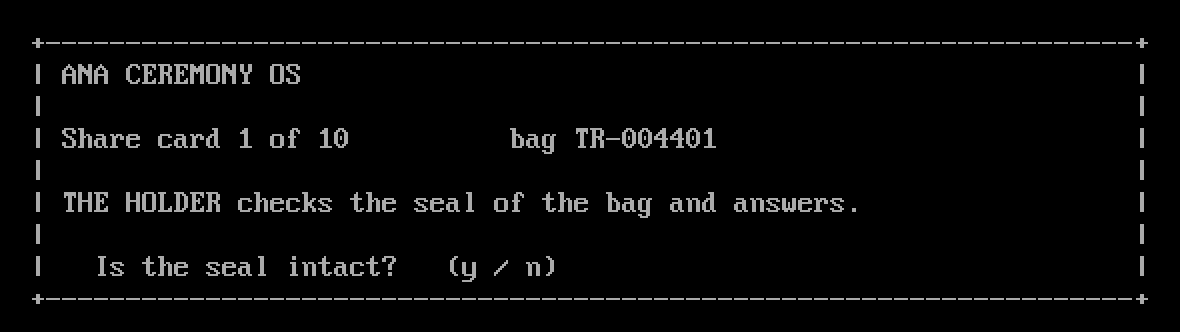
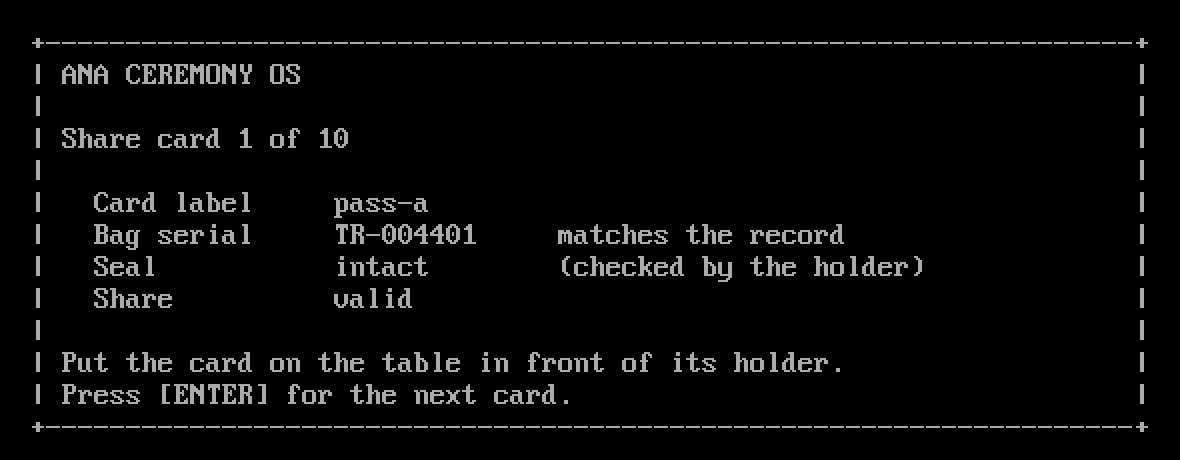
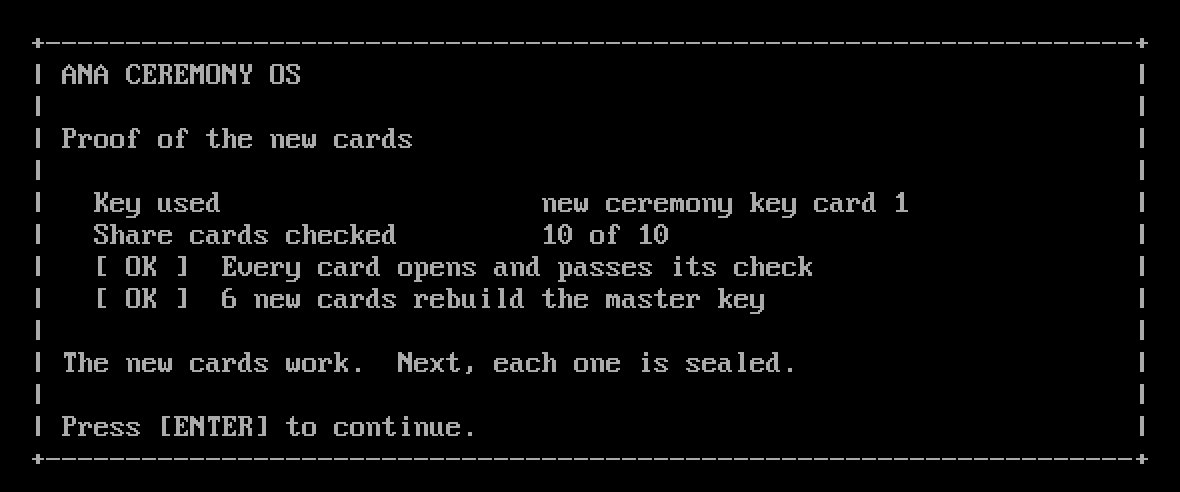
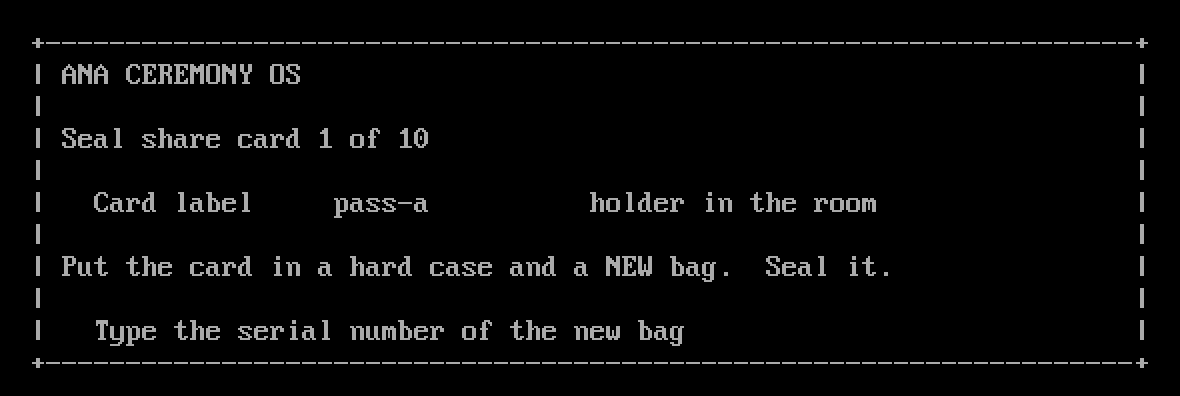
The master key is never held by a single person. It is split into share cards carried by several people, and a set number of them must be present to use it. Every card is checked, rewritten and proven to work before it is sealed back into its numbered bag.

Every important value is compared by two people and written on paper. The ceremony records are signed and can be verified later. When the ceremony ends, the memory is wiped and the machine powers off.

We set up Key Ceremony OS and run the ceremony together with your team for $2,000 per ceremony. If you do not have the hardware, we can source the dedicated laptop, share cards and tamper-evident bags for you; hardware is priced separately.

The whole system, kernel included, is about 4.5 MB: it contains only what the ceremony needs.

Sample Screens (from a test run)
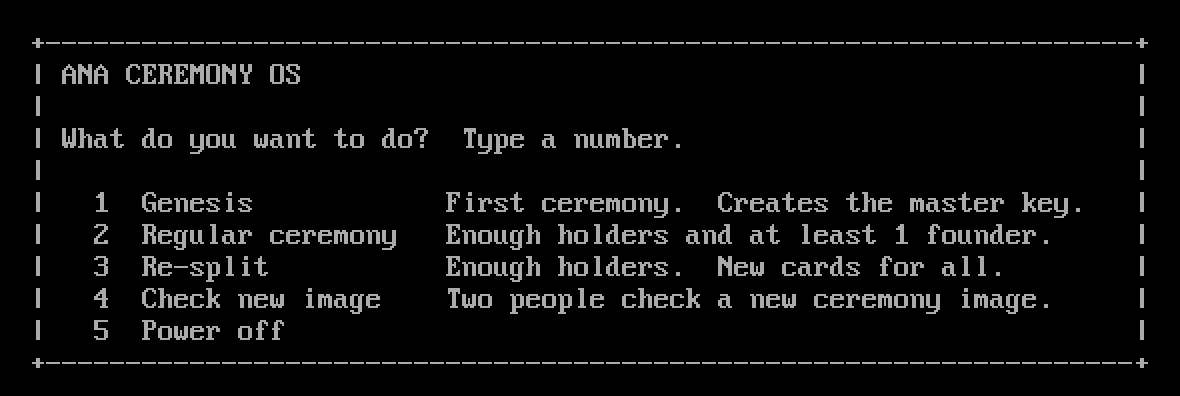
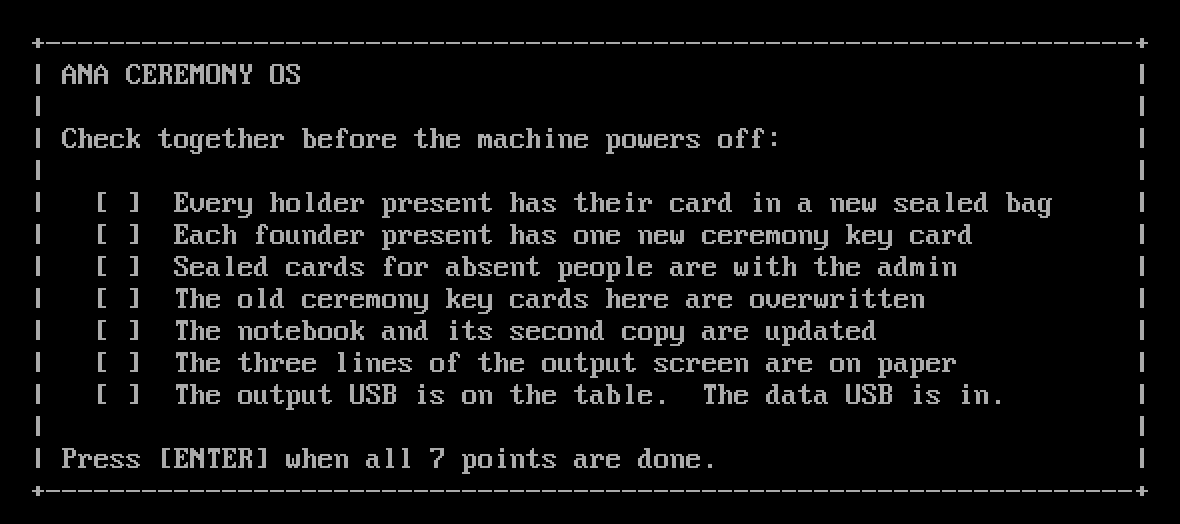
Ceremony mode menu The holder checks the seal of the bag A share card checked: seal intact, share valid Proof that the new cards rebuild the master key Sealing a share card in a new bag Closing checklist before power off

Planning your first key ceremony? Reach out on WhatsApp to discuss your setup, book a discovery call, or schedule a visit to your company.

HSM or Key Ceremony OS?

A hardware security module (HSM) and Key Ceremony OS solve different problems. Most organizations need an HSM for the keys that sign every day, and a controlled ceremony for the root key that is rarely used.

HSMKey Ceremony OS
Best forKeys that sign all the time: servers, certificate issuing, paymentsThe root key that is rarely used: creating it, renewing it, splitting it again
NetworkUsually connected; applications send it requestsNo network support at all; it stops if it finds a network interface or a wireless device
Where the key livesInside a single deviceNowhere permanently; it is split into share cards kept by different people in sealed, numbered bags
Single point of trustThe device and its administrator can become a single point of failureThe key cannot be used until the required number of card holders are together
HardwareA special, expensive, vendor-specific deviceAn ordinary laptop dedicated to this job
Vendor dependencyHigh: firmware, support contract, device lifetime and backup format belong to the vendorNone: the system is yours and its record formats are open
CostDevice price, recurring support and license fees, and a second device for backupA fixed fee per ceremony, with no license or support contract; the share cards are the backup
AuditabilityLogs stay inside the device, in the vendor's formatTwo people write every critical value on paper; ceremony records are signed and can be verified later
Physical protectionStrong: tamper-resistant hardware, certified productsThe process protects, not the device: the room, the seals, several witnesses and memory wiped at power off
Speed and volumeMany signatures per secondRare, planned ceremonies; not meant for daily signing

Most organizations use both: the root key stays offline with Key Ceremony OS and approves the intermediate keys that sign every day, and the daily signing is done with those intermediate keys on an HSM or a server.

Questions and Answers About Key Ceremony OS

Who is Key Ceremony OS for?

Organizations that sign their own software, updates, documents or devices and need to prove that their root keys were created and used under control: software and device makers, certificate issuers, and teams that run their own infrastructure.

We already have an HSM. Do we still need Key Ceremony OS?

An HSM protects the keys it holds, but it also has a root of trust, a backup and a recovery plan, and these often depend on a single administrator or on the vendor's backup mechanism. Key Ceremony OS puts the root key under a controlled ceremony with several holders, so no single person or vendor can use it or lose it.

How much does a key ceremony cost?

$2,000 per ceremony. This covers setting up Key Ceremony OS and running the ceremony together with your team. Hardware is priced separately; if you do not have it, we can source it for you.

Why does the machine have no network?

A machine that cannot connect cannot leak data over a network. The operating system has no network support at all, and it refuses to continue if it finds a network interface or a wireless device. Keys are created and used only in memory and leave the room only as sealed cards.

What happens if a card holder leaves or loses a card?

The required number of holders is enough to run a ceremony, so one missing card does not stop you. The key can be split again among a new group of holders, and the old cards are overwritten.

Have More Questions?

Have questions about our solutions? Message us on WhatsApp to discuss your goals, set up a virtual meeting, or arrange an on-site consultation.

How We Work

  1. Key Inventory & Roles

    We map which keys your organization relies on, what they sign, and who should carry the share cards.

  2. Ceremony Design

    We define the number of holders, how many must be present, the room, the paper records, and where the sealed cards are kept.

  3. Rehearsal

    We run a full rehearsal with test cards so everyone knows their role before any real key exists.

  4. First Ceremony & Ongoing Support

    We guide your first real ceremony, then support later ceremonies, holder changes and new versions.

Related Articles

View all articles →
Article

Air-Gapped Isn't Paranoid, It's Prudent

Why physical network isolation eliminates entire classes of attacks, and when air-gapping critical infrastructure provides the strongest protection against remote attacks.

4 min read Read
Article

Audit Logs Nobody Reviews Are Just Storage Costs

Why hoarding log data does not improve security and how active log review prevents incidents before damage occurs.

4 min read Read
Article

Documentation Is Insurance, Not Bureaucracy

Why clear system documentation protects business continuity and eliminates single-person dependency in software operations.

Enlarged view