
Most companies that run Linux take an operating system someone else built, install it, and then spend years adjusting it: turning services off, removing what they can, and hoping the next update does not bring it all back.
There is another way to think about it. Instead of owning a finished operating system, you can own the process that produces it.
When we build a custom operating system for a client, we also set up the build system that creates it.
A build system is the workshop where the operating system is made. It takes source code, a clear list of what the machine needs, and the rules your business has agreed on, and turns them into an installable image. The build is repeatable: the same inputs produce the same system every time.
This changes who is in control. If a component is no longer needed, it is removed from the list and the next image no longer contains it. If a security fix is published, the affected part is rebuilt and tested before it reaches a single workstation. Nothing changes on your machines unless it first changed in the build.
The build system works without depending on the internet. Everything it needs is kept locally: the source code, the tools, and the packages it produces. A remote service going offline, a repository changing its policy, or a supplier disappearing does not stop you from producing the next version of your own operating system.
It also gives you a record. Every image can be traced back to the exact sources and settings it was made from. When an auditor, an insurer, or your own team asks what is running on a machine, the answer is not a guess.
Owning the build does not mean doing everything alone. It means the knowledge and the means of production stay inside your organization, documented and repeatable, instead of living in a supplier's private infrastructure.
A custom operating system is valuable. The ability to build it again tomorrow is what makes it yours.
Full Source Handover & Production Network Architecture (SOURCE · BUILDER · KEY · UPDATE · LOG · BACKUP · GUARD)
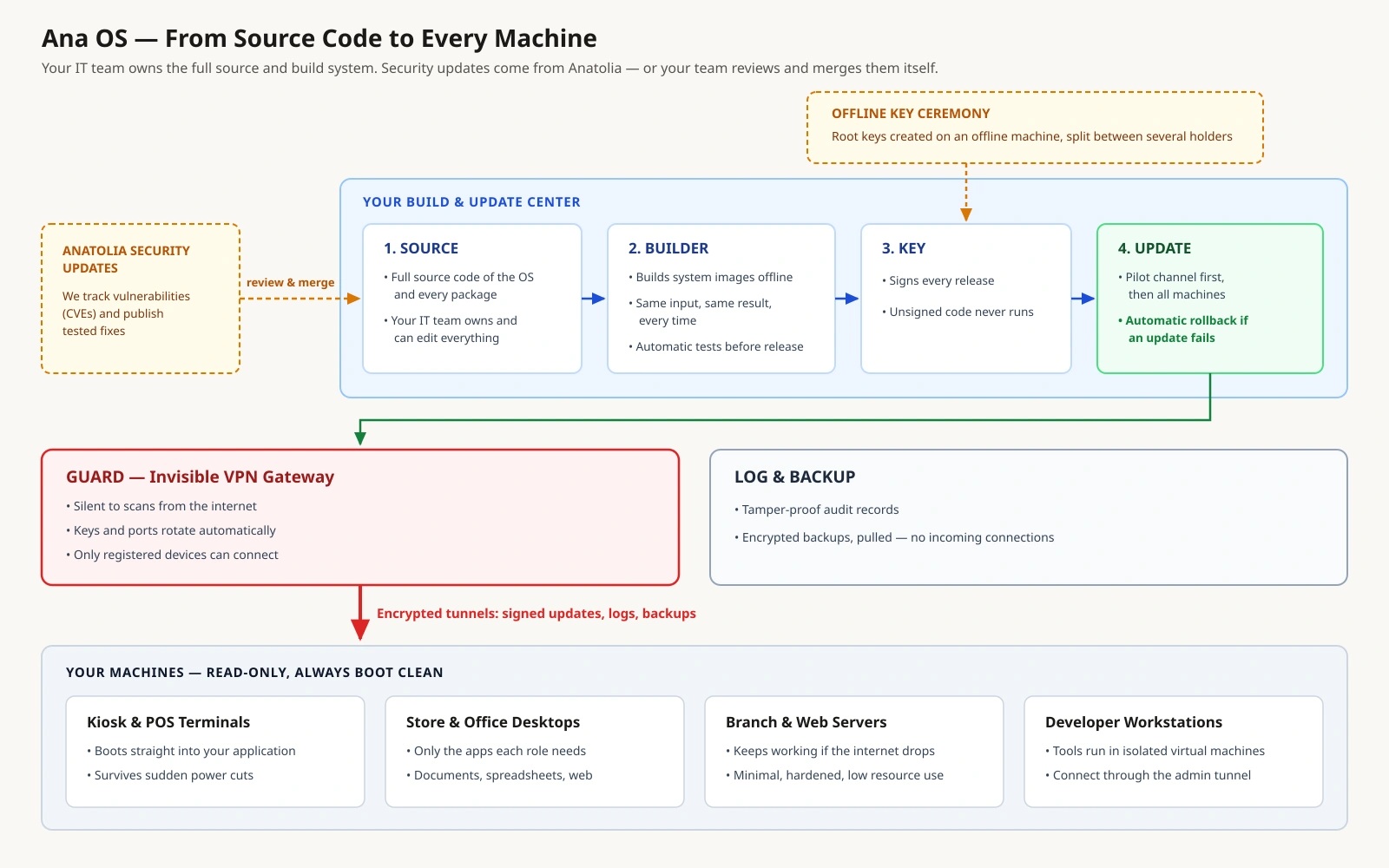
In the architecture we hand over, your IT team owns the entire production and security pipeline shown below, not just a closed image:
- SOURCE & BUILDER: The complete source code of all packages and the local package archive live on SOURCE. BUILDER compiles deterministic, repeatable OS images offline from source and validates every build through automated KVM virtual-machine acceptance tests.
- KEY & Offline Root of Trust (key ceremony and preparation): Built packages and unified kernel images (UKI) are signed by KEY servers using non-exportable TPM 2.0 keys. Optionally, signing can be authorized through an offline key ceremony that your organization controls.
- UPDATE, LOG & BACKUP: Signed packages are rolled out through the UPDATE server (which holds no signing keys) across testing and stable channels, with automatic rollback available as an option. LOG stores append-only audit records from all machines, while BACKUP listens on zero open ports and pulls encrypted backups outward.
- GUARD (Customized Invisible WireGuard Tunnel): Field workstations, POS/kiosk terminals, and developer desktops connect through GUARD. The tunnel stays completely silent to unrecognized scanners and supports smart split-tunneling for high-traffic media. Automatic key and port rotation and hardware-bound device enrollment can be added as optional hardening.
These hardening measures are optional, not defaults; you choose which ones your environment needs. If you want, these hardening options can be set up for you as part of our consulting engagement.
Prepared by the Anatolia Solutions team